


Picture-book reading in preschool: discuss difference without singling out a child
Plan a preschool picture-book conversation about difference without putting a classmate on display. Preparation, examples and varied participation.
 Nina Bakalová23 October 2026 · 7 min read

A picture book about difference can be a shared preschool story, rather than a public lesson about one classmate. Choose a manageable passage, offer different ways to participate and begin with the characters. No child needs to explain their diagnosis, speak for all autistic people or prove how closely they resemble a character.
There is an open book on the carpet. One child wants to turn the page, another is sitting on a chair and a third has noticed a tiny cup in the corner of the illustration. The adult has planned a conversation about understanding. The children are interested in the cup. That can still be a place to begin.
This article offers practical ideas for facilitating a reading activity. It is not a therapy protocol or an assessment of a particular class. All illustrative situations below were created for this article. They are not the author's personal memories or reports from named settings.
Give one session a manageable purpose
Instead of planning to explain the whole of neurodiversity, choose a smaller question. How can we invite someone to play while leaving them free to decline? What could an adult change when a room is too noisy? You may not find the answer on every page. The story can lead into a later conversation.
Keep the book's subject separate from a public discussion of a child's circumstances. You can talk about people needing different conditions without naming a classmate or sharing family information. Planning support for an individual child requires its own conversation with the family and appropriate staff. A reading circle does not replace that process.
NAEYC's guidance on inclusive classrooms, published on 25 July 2017, includes varied ways to participate, family communication and genuine friendships. A useful question for this activity is whether everyone has a way to join without becoming either the permanent helper or the permanent recipient of instruction.
Read the book yourself before bringing it to the group
Look at the illustrations and ending as well as the main text. Does a character have interests, choices and ideas, or exist mainly as a problem for others to solve? Does belonging depend on everyone behaving identically? These are useful selection questions, rather than a demand that every story deliver a perfect lesson.
Choose one spread where you might pause and one question worth exploring. You do not need to analyse the entire book in a single session. Our selection of picture books about feelings offers further starting points. Suit the choice to the group instead of assuming that an important subject automatically makes a title appropriate for every reading.
If considering TAMITOS Príbeh porozumenia, inspect the sample and product information before choosing a passage. This is our own book, recommended openly by the team behind TAMITOS. It is one possible resource, not a requirement for a useful conversation or a promise of a particular outcome for every child. Check the available edition rather than assuming that every format is identical.
Make the picture available to the whole group
Sit where the children will sit. Can you see the spread from there? Does light reflect off the page? Showing an illustration for a moment may leave some listeners finding the important detail just as you turn over. You might show the book slowly to both sides or read to a smaller group. Follow the book's permissions if you plan any reproduction.
Think about places to listen and take a break. A nearby chair may work better than the carpet for someone. The aim is a safe, supervised arrangement with a way to join, rather than a photograph in which every child sits in exactly the same position.
Describe the simple sequence beforehand: “We'll look at the story, then you can say or show something, and then we'll put the book away.” If you use a visual plan, make sure it reflects what will actually happen. One spread does not require an elaborate new display.
Start a conversation without making it a quiz
Show the cover and name the title, writer and illustrator from the edition in front of you. Then ask, “What did you notice?” Children do not have to identify a moral immediately. Pointing to a small object may be their way into a shared story.
Reading Rockets' group read-aloud guidance recommends previewing a book and keeping discussion from becoming a quiz. In practice, that can mean fewer successive questions and more time with one response. Not every page needs a discussion.
Illustrative situation: an adult shows a character beside a door and asks what might be happening. One child thinks the character wants to leave; another thinks they are waiting. The adult can say, “We can see a door. We don't know why they're there yet. Let's look at the next page.” Every posture does not need an invented psychological explanation.
A child who does not want to speak could point or continue listening. Our article on reading with a child who does not want to answer questions explores that separate issue. Participation need not take the form of a public performance.
When someone compares the character with a classmate
A comparison can arrive without an intention to hurt. The adult need not develop it into more questions about the named child. Bring the focus back: “We're talking about this character now. Everyone has their own story, and people don't have to tell us everything about themselves.”
Reading Rockets' discussion of picture books about autism cautions against making an autistic pupil a spokesperson for the diagnosis. A fictional character cannot represent everyone either. Sharing a diagnostic term does not make people's experiences identical.
Illustrative situation: a child says, “She covers her ears too.” The adult replies, “In the story, that happened when it was noisy. If something bothers someone, we can ask what they need. We aren't going to compare classmates now.” A group agreement about noise can be discussed without revealing personal health information.
This is not a rule against children ever choosing to talk about themselves. It keeps the invitation voluntary and prevents the adult from making someone the demonstration. A child can say something today and decline another conversation tomorrow.
Responding when a comment becomes hurtful
Do not leave the affected child responsible for preparing a lesson for everyone else. Stop the behaviour clearly without creating another spectacle: “We don't make fun of how someone speaks or moves.” There is no need for a public vote on who feels hurt or a compulsory hug in front of the group.
Decide whether continuing the story makes sense. Sometimes you need to close the book, attend to safety and return to the discussion separately. Repeated harm needs the setting's appropriate response with responsible adults. A fictional character cannot take over that responsibility.
For broader language about difference, our introduction to neurodiversity provides a starting point. It should not be used to assign diagnoses based on behaviour during a group activity.
Follow the story with one practical interaction
Instead of a worksheet with five lessons, try one small activity. Two puppets can practise an invitation to play and different answers: yes, no or perhaps later. Children can suggest a phrase, point to an option or watch. Nobody needs to perform the role of “the autistic child” or imitate a classmate's movements.
Illustrative situation: a puppet wants to join a building game. The adult tries, “Would you like a block?” They also demonstrate “not now”, and let the other puppet accept that answer. This explores a specific interaction, rather than testing who is the most empathetic.
You can return to the phrase during ordinary play. When reviewing the session, note what you might change in the arrangement or your instructions instead of writing a judgement such as “this child lacks empathy”. One book activity cannot reveal everything about the group's relationships.
Common questions
Do we need to tell the group who is autistic?
No. That information is not necessary for sharing the story. Decisions about personal information belong in appropriate conversations with the family, taking account of the child's needs and rights. They should not become an improvised announcement during reading.
What if the children only want to look at the pictures?
Stay with an illustration for a while. Notice one detail, read a short passage and decide whether to continue. You do not need to finish a planned conversation simply because it is written on the activity sheet.
How can we judge whether the activity was useful?
Consider whether the book was visible, children had accessible ways to join and the adult protected their privacy. A change in peer relationships cannot reliably be declared after one session. A useful conclusion may be modest: use a smaller group next time and leave longer with the picture.
More everyday conversations
A shared story can lead into play. Our guide to agreeing on the end of playground time explores another everyday agreement. If autism comes up in conversation, read why asking about language preferences matters.
Mom of two and co-founder of TAMITOS. For several years I have walked alongside our daughter on the autism spectrum, sharing real experiences from everyday life to bring more understanding and practical information to parents and everyone around them.
More articles
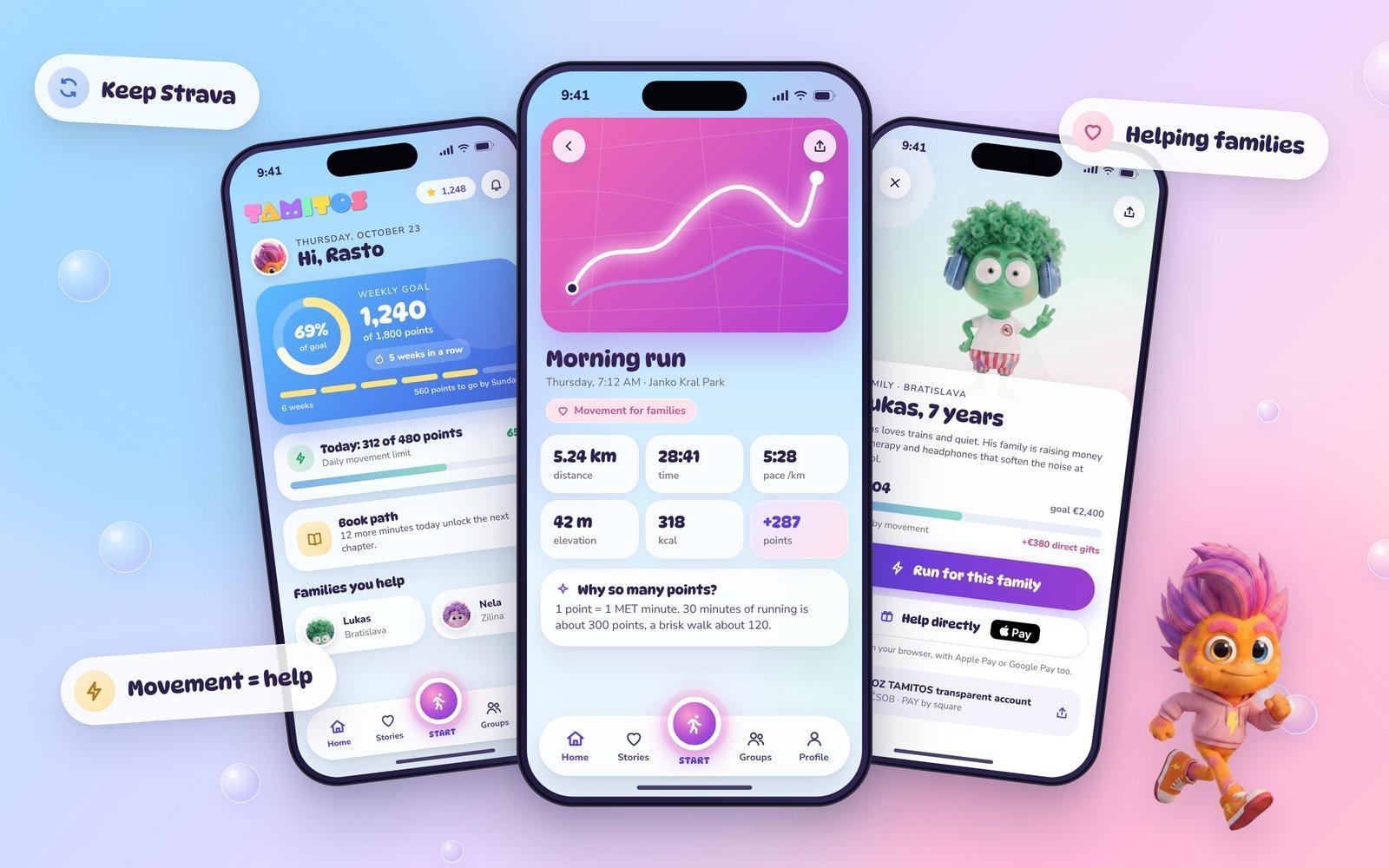
TAMITOS Move vs Strava: why run with an app that helps
TAMITOS Move is not just a charity app. It records your runs, walks and rides, gives you groups, photos, comme…
Autistic person or person with autism: why asking matters
Both “autistic person” and “person with autism” can belong in a respectful conversation. When referring to a p…
Leaving the playground: agreeing on the end of play
A final turn can mean different things to a parent and a child. Plan the end of playground time with honest ch…
 Free